I recently finished reading an article about roles in Software Architecture landscape, and it is incredibly timely for the current state of the industry.
In many companies today, there is a serious lack of understanding regarding what the Software/Solutions Architect role actually entails. It is a strange paradox: the higher the level of responsibility, the blurrier the expectations become. When a role lacks a clear definition, the Architect’s success depends almost entirely on luck rather than systemic alignment.
Below is a detailed breakdown of the key points and conclusions on how to fix this situation.
The Core of the Problem
When a role is undefined, the Architect’s success becomes a matter of chance. The article highlights several critical aspects:
1. Invisible Results A developer’s work is immediately visible through closed tickets and working features. An Architect’s work is the absence of future problems. If a system is stable and scales well, it looks like the Architect is doing nothing. If everything crashes, the Architect is blamed. It is a classic trap.
2. Cognitive Dissonance Companies fail to extract real value from this position because they do not know how to measure success. Meanwhile, the individuals in these roles struggle to understand what the expected outcome is.
3. Lack of Mandate An Architect often finds themselves as an advisor without a vote. They see technical risks but lack the authority to stop a wrong decision. Consequently, they get stuck between deep coding and endless meetings, with no real influence over the product or decisions made.
Visualizing the Problem: The Uncertainty Trap
The diagram below illustrates how the absence of a clear role turns the Architect into a decorative figure and communication into chaos:
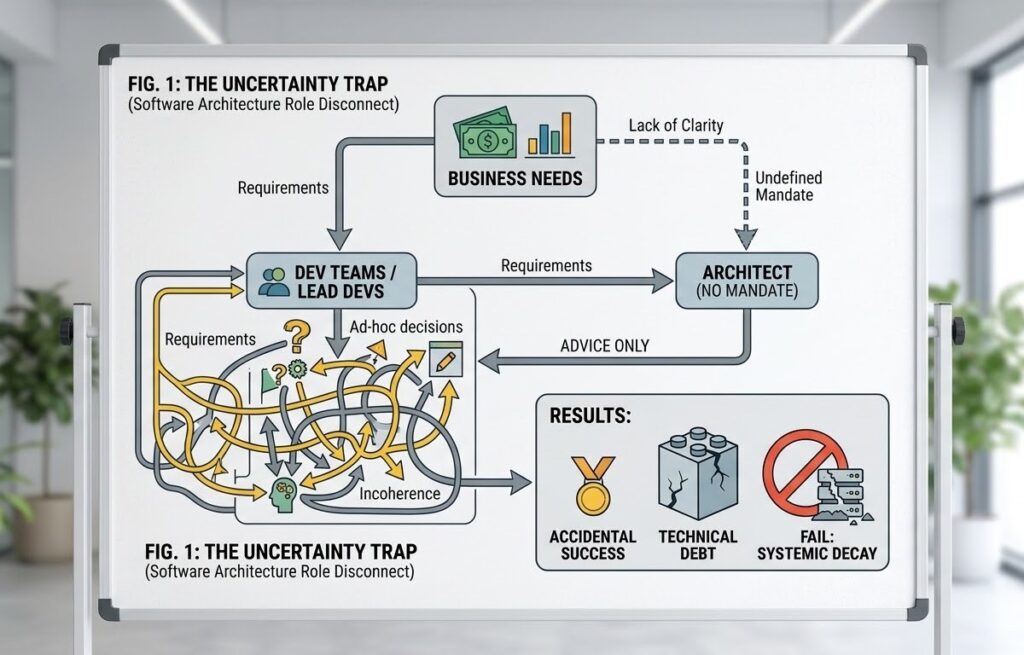
This diagram shows how, without a clear mandate, the Architect attempts to give advice that is often ignored. The Business side pushes requirements directly to developers, bypassing the Architect, which leads to Uncontrolled Scope. As a result, architects and teams receive mixed messages, leading to either accidental success or a mountain of Technical Debt.
Needless to say, an architect’s success in a case of uncertain expectations and without a mandate depends largely on luck.
How to Solve These Issues: A Systemic Approach
To stop the Architect role from being fake, four specific changes must be implemented:
1. Focus on Shared Understanding The primary product of an Architect’s work is not a set of diagrams, but a shared understanding of the system across the entire team. If every developer understands the principles behind the system, the Architect has succeeded.
2. Architecture as a Process, Not a Phase Architecture does not end at the design stage. It must accompany the entire development lifecycle. The Architect should be in the trenches, helping to implement solutions and adjusting them based on reality.
3. Establish a Mandate (Authority) The Architect must have a formal right to make technical decisions and align them with the long-term strategy. This is not about a dictatorship; it is about protecting the business’s investment in its codebase.
4. Efficiency Metrics Instead of abstract goals, introduce clear indicators: lead time for changes, frequency of failures due to architectural flaws, and the time required for onboarding new developers.
The Ideal Interaction Model (Target State)
In a proper structure, the Architect acts as the link that ensures a balance between speed (Business) and quality (Engineering):
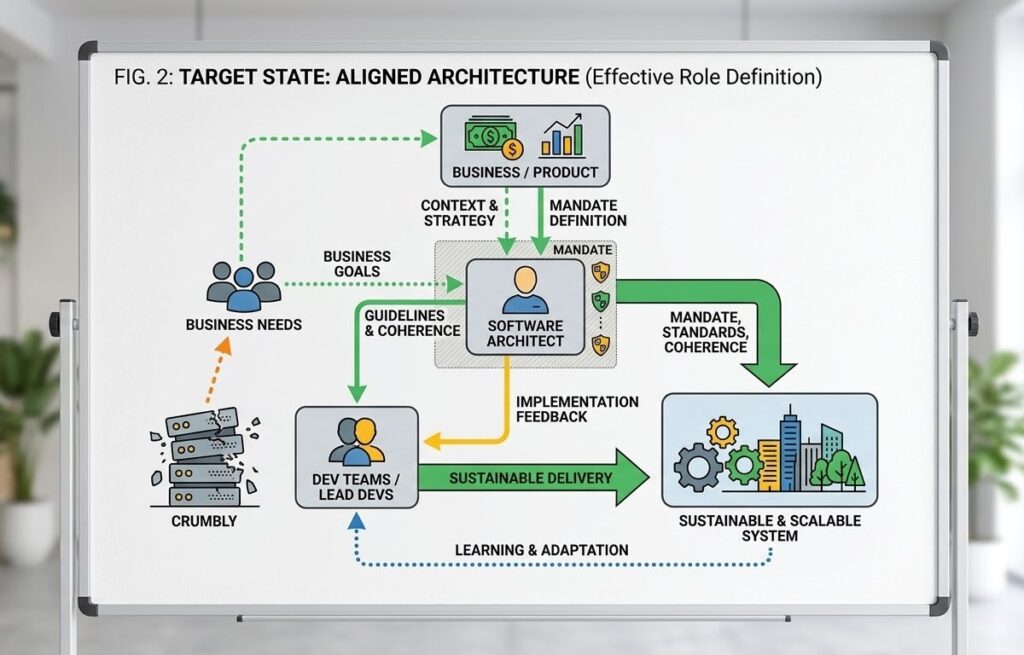
This scheme shows a healthy ecosystem. The Business/Product side clearly communicates goals. The Software Architect holds a mandate, creates guidelines and ensures coherence, which are then passed to the teams. Dev Teams implement these solutions and provide feedback. This cycle ensures the creation of a Sustainable & Scalable System.
Final Thoughts
I completely share the views expressed in this piece. Architecture is a critical function, not just a title. If we do not define the rules of the game and provide the Architect with tools for influence, the success of our projects depends on chance only.
Highly recommend giving the original article a read:
https://www.cloudwaydigital.com/post/is-software-architect-a-fake-role
Leave a Reply